
The best-known and longest-practised form of what is commonly called stem cell therapy is bone marrow transplantation for patients with leukaemia and other haematological malignancies. It has been an established standard treatment for decades [1]. Over the past 10 to 15 years, however, cell-based therapies (CBT) have increasingly been performed for non-malignant diseases, mostly described as “stem cell therapies” and grouped under the heading of “regenerative medicine”. Yet these treatments differ considerably from one another, and also from the classic bone marrow transplant, so they cannot be lumped together under a single label.
The biological activity and clinical effect of a CBT are determined by how it is performed. For a long time, however, the field lacked a standardized nomenclature to describe these procedures: heterogeneous preparations such as bone marrow aspirate concentrate (BMAC), stromal vascular fraction (SVF) and culture-expanded mesenchymal stromal cells were collectively referred to as “stem cells”, although true stem and progenitor cells typically represent only a minor fraction of the administered cell population. This inconsistent terminology limits the comparability of clinical studies, impedes the pooling of data in systematic reviews and meta-analyses, and obscures relevant differences in safety and efficacy.
To address this, an international panel of experts developed a standardized communication tool in a structured consensus process (Delphi method) [2]. The result is the DOSES tool, which describes every cell therapy using five core items:
Each of the five items is decisive for the type of therapy. A therapy using the patient’s own bone marrow cells, prepared at the point of care and injected into a joint, is fundamentally different from one using donor cells expanded in a laboratory and given intravenously, even if both are called “stem cell therapy”. The DOSES tool is intended for researchers, clinicians, regulators and industry alike [2].
CBTs for non-malignant diseases are being applied and studied across a broad range of indications. These include orthopaedic and musculoskeletal conditions, such as joint, tendon and spinal disorders, as well as neurological diseases and developmental disorders, for example amyotrophic lateral sclerosis (ALS), spinal cord injury (SCI), cerebral palsy (CP) and autism spectrum disorder (ASD) [5–8]. The level of evidence differs considerably between indications. Some applications are supported by growing clinical data, while others are still under investigation.
Many of these treatments are autologous: the patient’s own cells are harvested, prepared and returned, often within a single procedure. Because the treatment is tailored to the individual patient, from the cells used to the site of delivery, it is often also referred to as individual or personalized therapy. This requires particular care in patient selection, informed consent and the documentation of results.
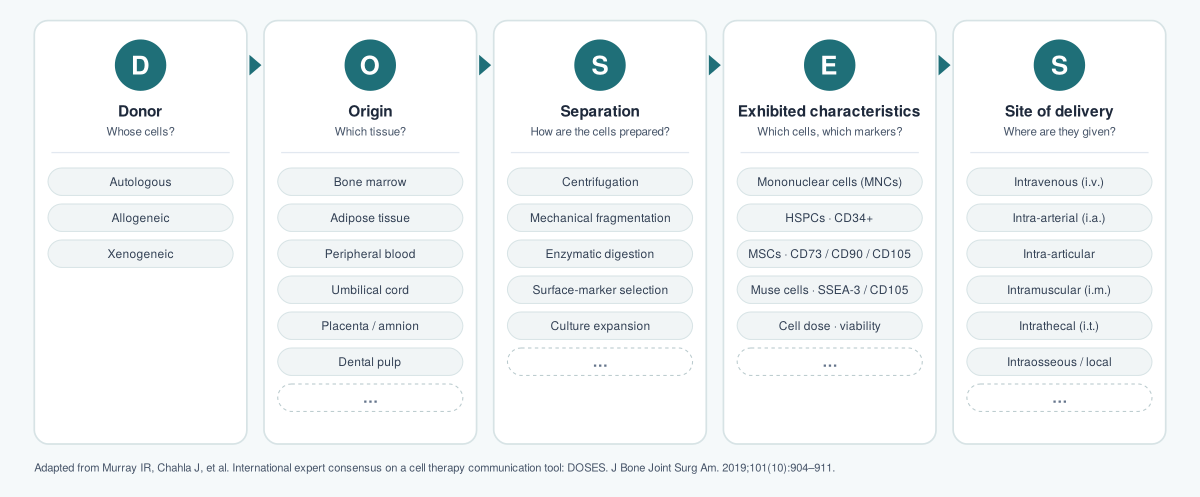
RegMed Austria encourages its members to use DOSES in publications, case discussions and patient information. Only when a therapy is described precisely can its results be compared, its safety assessed and its value for patients judged fairly. How these differences affect the legal status of a treatment, for example whether it counts as standard therapy, will be covered on a dedicated page, coming soon.