Safety and efficacy of autologous cell-based therapies for autism spectrum disorders

Autism spectrum disorders (ASD) are increasingly linked to immune dysregulation and neuroinflammation. Autologous cell-based therapies use the patient’s own cells, so there is no risk of rejection or graft-versus-host disease. Their proposed mechanisms include paracrine and immunomodulatory effects that attenuate neuroinflammation. A contribution to neuroregeneration has also been discussed. This page lists all peer-reviewed clinical studies of autologous cell therapy in ASD.
Key points at a glance

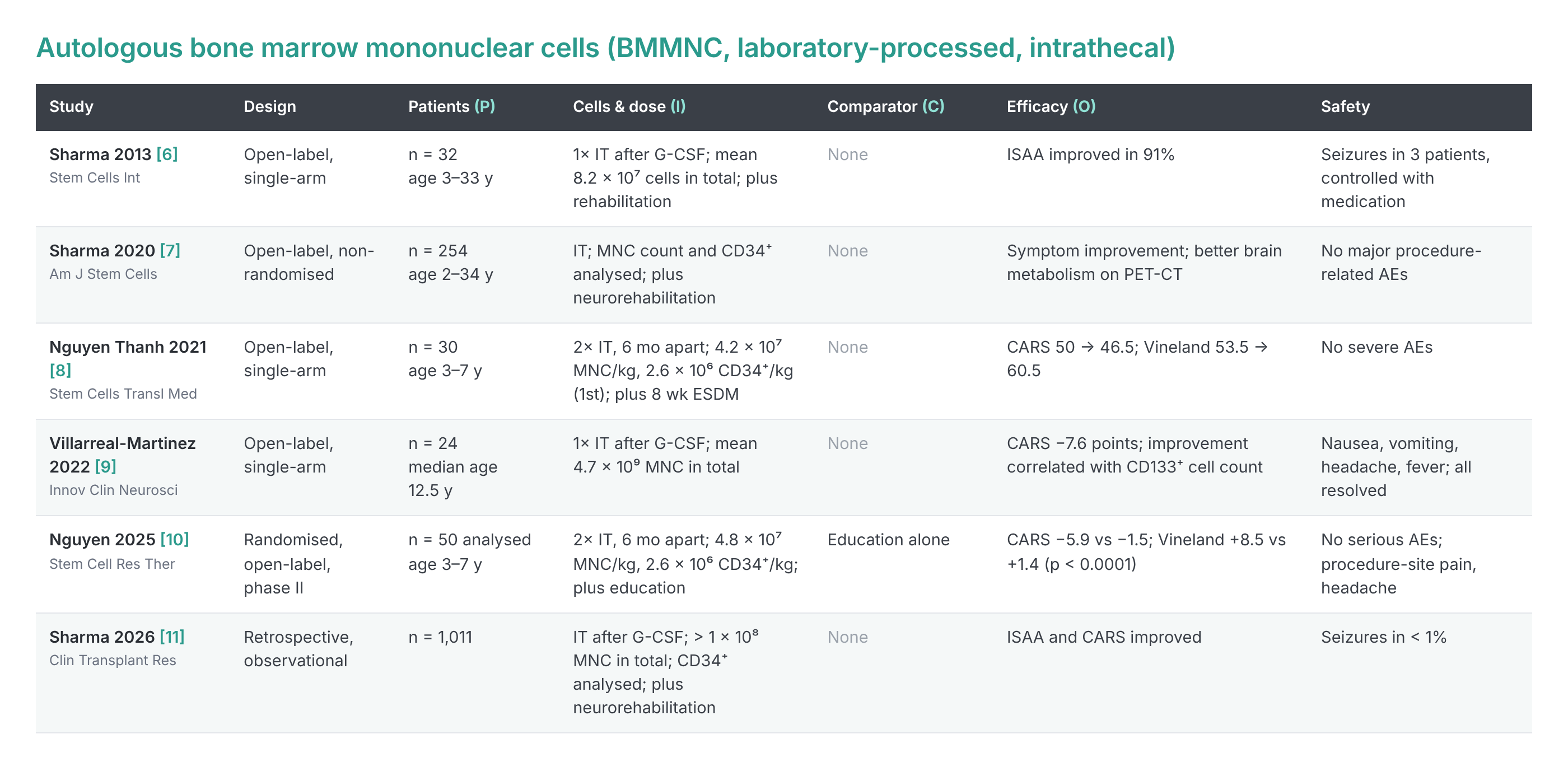
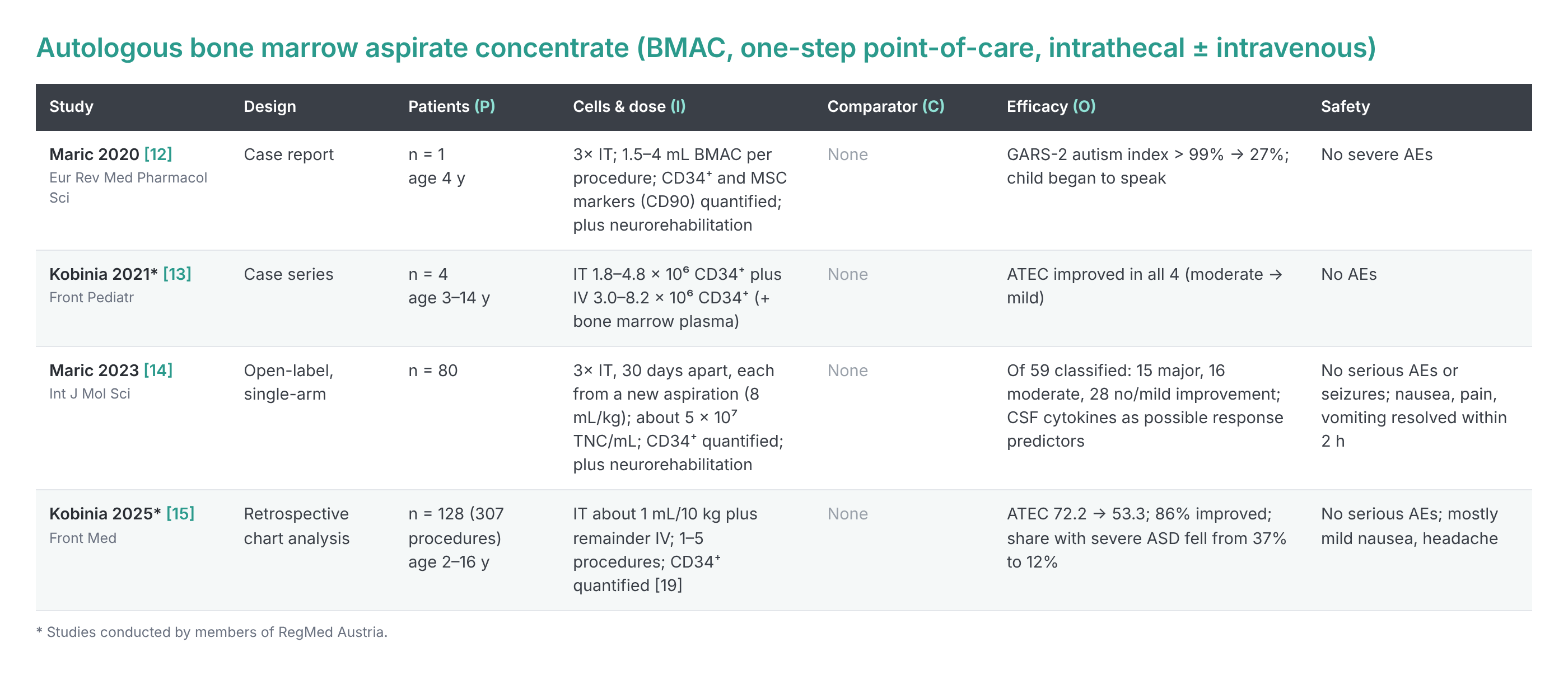
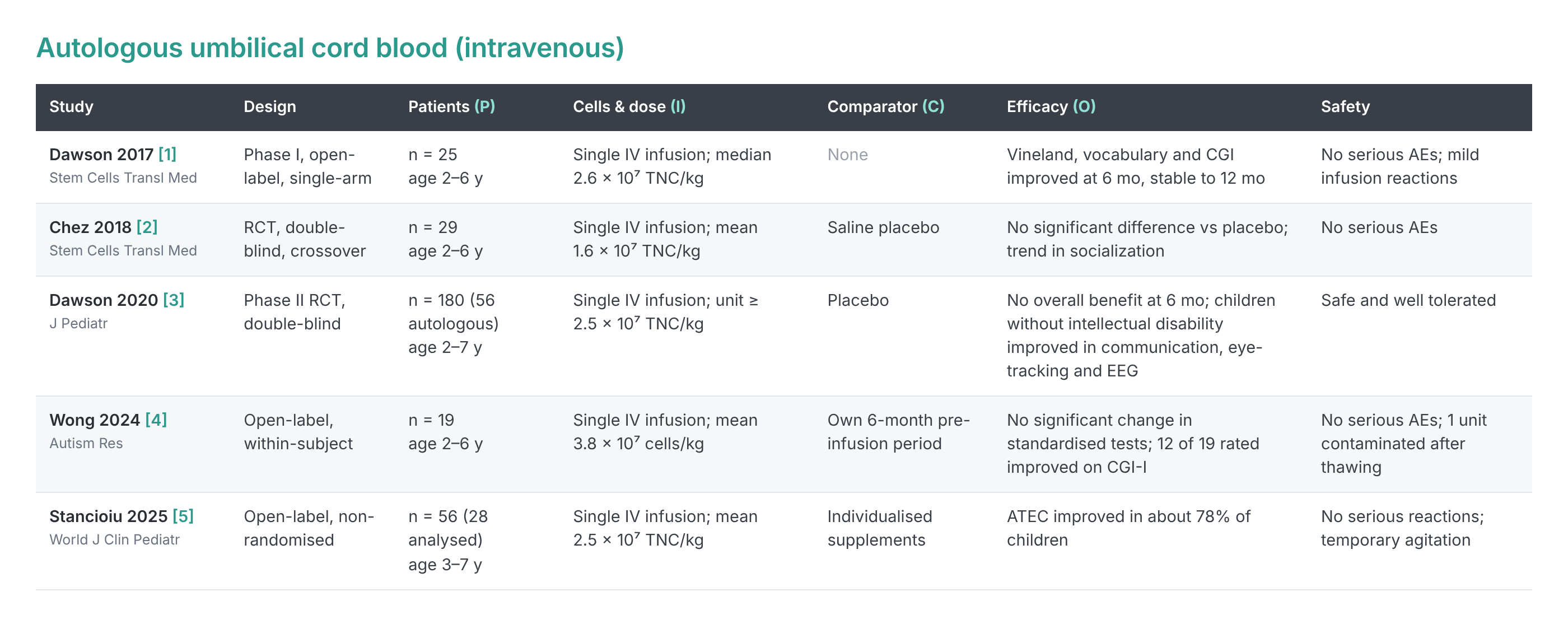
  • 16 publications with more than 1,700 treated patients [1–16].
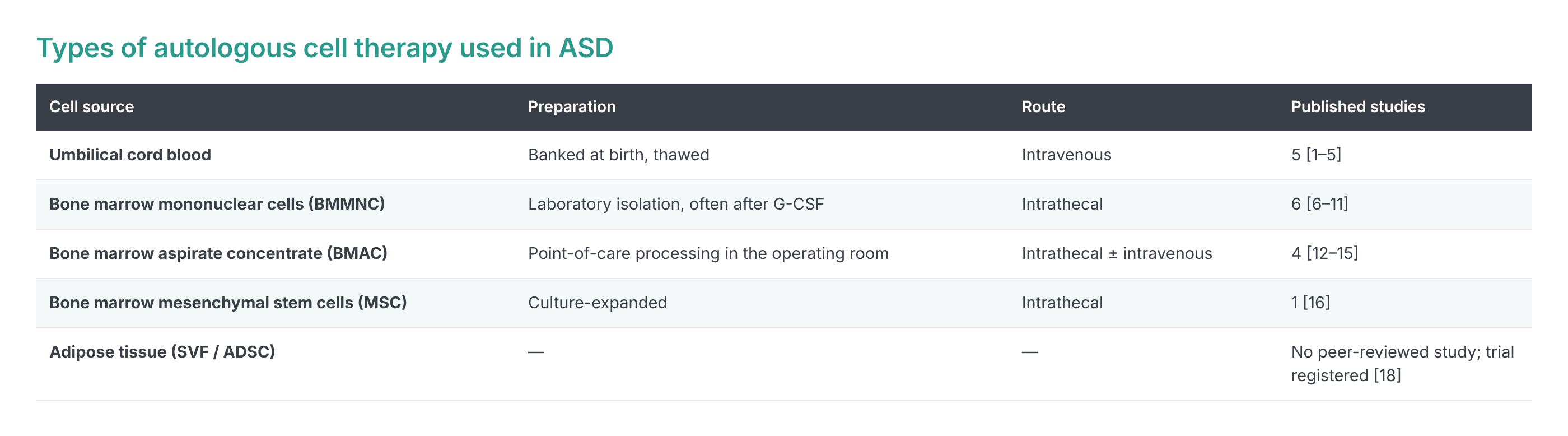
  • DOSES: Using the DOSES tool [17], the published therapies can be characterised as follows:
    • Donor: autologous in all studies [1–16].
    • Origin: umbilical cord blood [1–5] or bone marrow [6–16]; for adipose tissue, no peer-reviewed clinical study has been published to date, but a trial is registered [18].
    • Separation: thawed banked cord blood units [1–5]; laboratory-isolated mononuclear cells [6–11], partly after G-CSF mobilisation [6, 9, 11]; point-of-care bone marrow concentrate [12–15]; culture-expanded MSCs [16].
    • Exhibited characteristics: reported inconsistently, as total nucleated cells (TNC) [1–5, 14], mononuclear or total cell counts [6–11, 16], CD34⁺ cells [1, 5, 7, 8, 10–15], CD133⁺ cells [9], or MSC surface markers by flow cytometry [12, 14, 16]. Cell doses are thus reported per kg body weight, per mL or as absolute numbers, which limits direct comparison. The CD34⁺ quantification used in [15] is described in [19].
    • Site of delivery: intravenous for cord blood [1–5]; intrathecal for bone marrow-derived cells [6–16], combined with intravenous application in [13, 15].
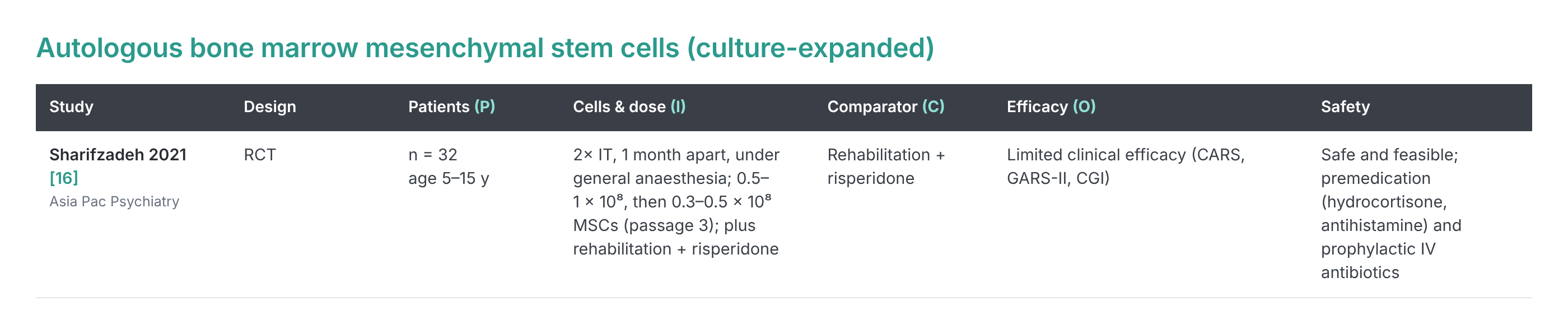
  • Efficacy: Open-label studies, in which patients, parents and investigators know which treatment was given and which mostly have no control group, consistently report improvements [1, 5–9, 11–15]. Among the controlled trials, the cord blood studies [2, 3] and the MSC trial [16] found no significant overall benefit on their primary endpoints. Secondary and subgroup analyses, however, showed signals: in [2], Vineland socialization scores improved after cord blood compared with placebo, although this was no longer significant after correction for multiple testing; in [3], children without intellectual disability improved in communication, sustained attention on eye-tracking and EEG alpha/beta power. One randomised open-label bone marrow trial [10] found a clear benefit over education alone on CARS, CGI and Vineland scores after 12 months.
  • Safety: No study reported a serious treatment-related adverse event (SAE). Side effects were mostly mild and transient: infusion reactions, headache, nausea, back pain, temporary agitation, and rare seizures after intrathecal application [6, 11].

Discussion

The heterogeneity of the published therapies, particularly in separation and reported cell characteristics, limits comparability between studies. The reasons for the divergent efficacy results remain unclear, and several factors may contribute. Each approach has specific advantages and limitations.

Cell source: cord blood versus bone marrow

  • Umbilical cord blood [1–5] contains young, immunologically naive cells and requires no harvest procedure: the infusion is simple and needs no anaesthesia. However, it is only available if a unit was banked at birth, the cell number is fixed and decreases per kg body weight as the child grows, and treatment usually cannot be repeated. Cryopreservation requires DMSO, which can cause transient side effects.
  • Bone marrow [6–16] is available to every patient, and harvesting can be adapted to body weight and repeated. Its drawbacks are the need for bone marrow aspiration under sedation or general anaesthesia and a cell yield that varies between individuals and with age.

Processing: BMMNC, BMAC and culture-expanded MSCs

  • Bone marrow mononuclear cells (BMMNC) [6–11] are isolated in a laboratory by density-gradient centrifugation (e.g. Ficoll). This yields a defined mononuclear fraction of lymphocytes, monocytes and haematopoietic progenitor cells (CD34⁺), with few MSCs, while red cells, granulocytes, platelets and plasma are removed. Harvest and application can take place on the same day, but the method requires laboratory infrastructure and more processing time.
  • Bone marrow aspirate concentrate (BMAC) [12–15] is produced by automated centrifugation in a closed system directly in the operating room. Harvest, concentration and application take place in a single session under one anaesthesia (one-step procedure). The concentrate contains all nucleated cells, including granulocytes and platelets, and the plasma supernatant, which is rich in cytokines and growth factors, can be returned intravenously [13, 15]. Because the concentrate is applied immediately, cell counts are less precisely defined before application.
  • Culture-expanded MSCs [16] allow a high and well-characterised dose of a single cell type. They require bone marrow harvest, several weeks of GMP laboratory culture and separate application procedures. In [16], this meant three general anaesthesias (aspiration and two intrathecal injections), premedication with hydrocortisone and an antihistamine, prophylactic intravenous antibiotics and a 72-hour hospital stay per injection. Culture-expanded MSCs also lack the monocytes and haematopoietic progenitors contained in BMMNC and BMAC.

Route of administration

  • All cord blood studies used intravenous infusion [1–5]. Intravenous application is simple and needs no lumbar puncture, but it has two main disadvantages. First, a large proportion of cells is retained in the lungs, liver, and spleen (pulmonary first-pass effect). Second, the few cells that remain in circulation must cross the blood–brain barrier, which largely prevents cell entry into the central nervous system. Effects may therefore be mediated mainly by systemic immunomodulation or by paracrine factors (e.g. cytokines, extracellular vesicles) rather than by cells acting directly within the brain. Intrathecal application bypasses both obstacles by delivering cells directly into the cerebrospinal fluid.
  • Intrathecal application [6–16] delivers cells directly into the cerebrospinal fluid but requires a lumbar puncture, usually under sedation in children, and is associated with headache, back pain and rarely seizures. A combined intrathecal and intravenous application [13, 15] aims to address both the central nervous system and systemic immune dysregulation.
  • However, the MSC trial [16] also used the intrathecal route and showed limited efficacy, so the route alone does not explain the differences. Possible reasons include the older age of participants (5–15 years), a cell type without monocytes and haematopoietic progenitors, a small sample size (n = 32), and the fact that both groups received risperidone and rehabilitation, which may have masked an additional effect.

Number of applications

  • Several studies applied cells repeatedly, two to five times [8, 10, 12, 14–16]. In the largest BMAC cohort, the greatest improvement occurred after the first procedure [15]. The optimal number and interval of applications have not been established.

Cell dose

  • Cord blood provides considerably fewer cells per kg body weight than bone marrow preparations, and its composition differs. In the cord blood studies, about 1.6–3.8 × 10⁷ TNC/kg were infused, with a median of only about 0.3 × 10⁵ CD34⁺ cells/kg [1]; in the bone marrow trials, about 4.2–4.8 × 10⁷ MNC/kg and 2.1–2.6 × 10⁶ CD34⁺ cells/kg were applied per procedure [8, 10].

Patient selection

  • Subgroup analyses suggest that younger children and children without intellectual disability or with less severe ASD respond better [1, 3, 5, 10]. Heterogeneous study populations may therefore dilute treatment effects.

Study design and the ethics of sham procedures

  • The negative trials were randomised and partly blinded [2, 3]. The positive randomised trial [10] was open-label, without sham treatment of the control group. Expectation effects may therefore contribute to the differences, particularly on parent-reported scales.
  • At the same time, sham-controlled designs are ethically highly questionable for bone marrow-derived therapies: a sham bone marrow aspiration and lumbar puncture under anaesthesia would expose children to procedural risks without any potential benefit. A placebo control is more easily justified for intravenous cord blood, which is already banked and requires no additional intervention [2, 3]. Alternatives include blinded outcome assessment, delayed-treatment or crossover designs, and objective biomarkers such as EEG, eye-tracking or cerebrospinal fluid cytokines [3, 14].

References

  1. Dawson G, Sun JM, Davlantis KS, et al. Autologous cord blood infusions are safe and feasible in young children with autism spectrum disorder: results of a single-center phase I open-label trial. Stem Cells Transl Med. 2017;6(5):1332–1339. doi:10.1002/sctm.16-0474. https://doi.org/10.1002/sctm.16-0474
  2. Chez M, Lepage C, Parise C, Dang-Chu A, Hankins A, Carroll M. Safety and observations from a placebo-controlled, crossover study to assess use of autologous umbilical cord blood stem cells to improve symptoms in children with autism. Stem Cells Transl Med. 2018;7(4):333–341. doi:10.1002/sctm.17-0042. https://doi.org/10.1002/sctm.17-0042
  3. Dawson G, Sun JM, Baker J, et al. A phase II randomized clinical trial of the safety and efficacy of intravenous umbilical cord blood infusion for treatment of children with autism spectrum disorder. J Pediatr. 2020;222:164–173.e5. doi:10.1016/j.jpeds.2020.03.011. https://doi.org/10.1016/j.jpeds.2020.03.011
  4. Wong CM, Tan CS, Riard N, et al. Autologous umbilical cord blood infusion for the treatment of autism in young children: a within-subjects open label study on safety (assessed via caregiver report) and efficacy. Autism Res. 2024;17(8):1721–1734. doi:10.1002/aur.3187. https://doi.org/10.1002/aur.3187
  5. Stancioiu FA, Bogdan R, Ivanescu B, Dumitrescu R. Autologous cord blood vs individualized supplements in autistic spectrum disorder: CORDUS study results. World J Clin Pediatr. 2025;14(1):96643. PMID: 40059901. https://pubmed.ncbi.nlm.nih.gov/40059901/
  6. Sharma A, Gokulchandran N, Sane H, et al. Autologous bone marrow mononuclear cell therapy for autism: an open label proof of concept study. Stem Cells Int. 2013;2013:623875. doi:10.1155/2013/623875. https://doi.org/10.1155/2013/623875
  7. Sharma AK, Gokulchandran N, Kulkarni PP, et al. Cell transplantation as a novel therapeutic strategy for autism spectrum disorders: a clinical study. Am J Stem Cells. 2020;9(5):89–100. PMID: 33489466. https://pubmed.ncbi.nlm.nih.gov/33489466/
  8. Nguyen Thanh L, Nguyen HP, Ngo MD, et al. Outcomes of bone marrow mononuclear cell transplantation combined with interventional education for autism spectrum disorder. Stem Cells Transl Med. 2021;10(1):14–26. doi:10.1002/sctm.20-0102. https://doi.org/10.1002/sctm.20-0102
  9. Villarreal-Martinez L, Martínez-Garza LE, Rodriguez-Sanchez IP, Alvarez-Villalobos N, Guzman-Gallardo F, Pope-Salazar S, Salinas-Silva C, Cepeda-Cepeda MG, Garza-Bedolla A, Dominguez-Varela IA, Villarreal-Martinez DZ, Treviño-Villarreal JH, Gomez-Almaguer D. Correlation between CD133+ stem cells and clinical improvement in patients with autism spectrum disorders treated with intrathecal bone marrow-derived mononuclear cells. Innov Clin Neurosci. 2022;19(4–6):78–86. PMID: 35958968; PMCID: PMC9341312. https://pubmed.ncbi.nlm.nih.gov/35958968/
  10. Nguyen LT, Nguyen PM, Nguyen HP, et al. Outcomes of autologous bone marrow mononuclear cell administration combined with educational intervention in the treatment of autism spectrum disorder: a randomized, open-label, controlled phase II clinical trial. Stem Cell Res Ther. 2025;16:268. doi:10.1186/s13287-025-04404-4. https://doi.org/10.1186/s13287-025-04404-4
  11. Sharma A, Gokulchandran N, Sane H, Kulkarni P, Kannan K, Shaikh Z, Biju H, Paranjape A, D’sa M, Badhe P. Autologous bone marrow mononuclear cell administration in a large cohort of 1,011 patients with autism spectrum disorder: a retrospective observational study. Clin Transplant Res. 2026;40(1):116–128. doi:10.4285/ctr.25.0009. PMID: 41407289; PMCID: PMC13019111. https://doi.org/10.4285/ctr.25.0009
  12. Maric DM, Papic V, Radomir M, et al. Autism treatment with stem cells: a case report. Eur Rev Med Pharmacol Sci. 2020;24(15):8075–8080. doi:10.26355/eurrev_202008_22491. https://doi.org/10.26355/eurrev_202008_22491
  13. Kobinia GS, Zaknun JJ, Pabinger C, Laky B. Case report: autologous bone marrow derived intrathecal stem cell transplant for autistic children – a report of four cases and literature review. Front Pediatr. 2021;9:620188. doi:10.3389/fped.2021.620188. https://doi.org/10.3389/fped.2021.620188
  14. Maric DM, Vojvodic D, Maric DL, et al. Cytokine dynamics in autism: analysis of BMAC therapy outcomes. Int J Mol Sci. 2023;24(20):15080. doi:10.3390/ijms242015080. https://doi.org/10.3390/ijms242015080
  15. Kobinia GS, Bukaty A, Holly E, Kobinia G, Heuberer PR, Laky B. Intrathecal injection of bone marrow concentrate in children with autism spectrum disorder: a retrospective chart analysis. Front Med. 2025;12:1666486. doi:10.3389/fmed.2025.1666486. https://doi.org/10.3389/fmed.2025.1666486
  16. Sharifzadeh N, Ghasemi A, Tavakol Afshari J, et al. Intrathecal autologous bone marrow stem cell therapy in children with autism: a randomized controlled trial. Asia Pac Psychiatry. 2021;13(2):e12445. doi:10.1111/appy.12445. https://doi.org/10.1111/appy.12445
  17. Murray IR, Chahla J, Safran MR, Krych AJ, Saris DBF, Caplan AI, LaPrade RF; Cell Therapies Communication Expert Group. International expert consensus on a cell therapy communication tool: DOSES. J Bone Joint Surg Am. 2019;101(10):904–911. doi:10.2106/JBJS.18.00915. https://doi.org/10.2106/JBJS.18.00915
  18. gov. NCT07546942: Multimodal interventions with cellular stromal vascular fraction (cSVF), autologous mesenchymal stem cells, fecal microbiota transplantation and diet modification in autism spectrum disorder. https://clinicaltrials.gov/study/NCT07546942
  19. Pabinger C, Laky B, Heuberer PR, Kobinia GS. Bone marrow derived CD34+ cells and leukocytes in 729 children and adults with non-malignant diseases. Stem Cell Rev Rep. 2021;17(4):1508–1510. doi:10.1007/s12015-021-10173-3. https://doi.org/10.1007/s12015-021-10173-3